Log #22 · Sep 27, 2026
LiPo vs Li-ion vs NiMH: Batteries for Projects
Compare voltage, capacity, current and safety of LiPo, Li-ion 18650 and NiMH batteries, and learn how to choose and charge them for robots.
Batteries decide how long your robot runs, how fast its motors spin and, if handled carelessly, whether your workbench stays in one piece. Three rechargeable chemistries dominate hobby electronics: LiPo pouches, cylindrical Li-ion cells like the 18650, and NiMH AA packs. This guide compares them with real numbers and explains the safety rules that matter.
The key numbers on a battery
- Nominal voltage: the average voltage during discharge.
- Capacity (mAh): how much charge it holds. A 2000 mAh battery can in theory supply 2000 mA for one hour, or 200 mA for ten hours.
- Discharge rate (C rating): the maximum safe current as a multiple of capacity. A 1000 mAh pack rated 20C can supply 20 A.
- Cell count (S): lithium packs are described by cells in series. A 2S pack has two cells, a 3S has three.
Comparison
| LiPo | Li-ion (18650) | NiMH (AA) | |
|---|---|---|---|
| Voltage per cell | 3.7 V nominal, 4.2 V full | 3.6–3.7 V nominal, 4.2 V full | 1.2 V |
| Energy for its weight | High | High | Medium |
| Maximum current | Very high (20C+ common) | Moderate (often 5–10 A per cell) | Moderate |
| Shape | Flat pouch, many sizes | Standard cylinder, 18 × 65 mm | Standard AA |
| Physical toughness | Soft pouch, easily punctured | Steel can, robust | Robust |
| Safety | Needs the most care | Needs care | Very forgiving |
| Charging | Balance charger required | Li-ion charger or protected board | Simple NiMH charger |
LiPo: maximum power, maximum care
LiPo packs are what drones and RC cars use. They deliver huge currents, come in flat shapes that fit tight spaces and are very light for their capacity. A 2S 1000 mAh pack is a great match for a fast, small robot.
Rules for LiPo:
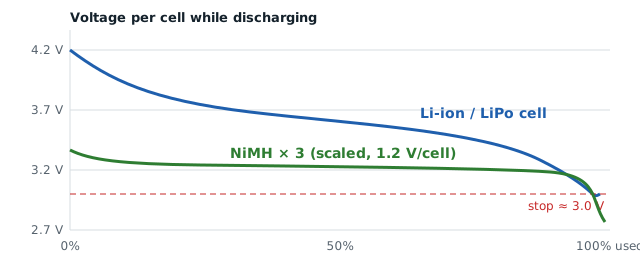
- Never discharge below about 3.0 V per cell. Over-discharged LiPos can be permanently damaged and unsafe to recharge. Use a low-voltage alarm or cut-off.
- Charge only with a balance charger, which keeps every cell at the same voltage, and never leave charging unattended.
- Store at about 3.8 V per cell if you will not use the pack for a while.
- Retire any pack that puffs up. A swollen pouch means internal damage.
- Charge and store in a fire-resistant LiPo bag.
Li-ion 18650: the robust all-rounder
The 18650 is the cell inside many laptop packs and power tools. Its steel case makes it much tougher than a pouch, and a good cell holds 2500–3500 mAh. Two in series in a holder give a 2S, 7.4 V nominal pack, ideal for Arduino robots with a TB6612 motor driver.
Tips:
- Buy cells from reputable brands and sellers. Fake cells with inflated capacity ratings are common.
- Prefer protected cells or use a BMS (battery management system) board, which cuts off over-charge, over-discharge and short circuits.
- For single cells, a TP4056-type charging module with protection is a cheap, common way to charge at 5 V from USB.
NiMH: safe and simple
NiMH AAs are the safest choice, especially for beginners and classrooms. Four in series give 4.8 V, which suits servos and 5 V electronics well. They tolerate abuse, cannot catch fire in the dramatic way lithium can and charge in any standard NiMH charger. Low self-discharge types, often labeled "pre-charged", hold their charge for months.
The downsides are weight and voltage: 4.8 V is a little low for an Arduino's barrel jack, and they carry less energy per gram than lithium.
How long will it last?
A simple estimate:
runtime (hours) ≈ capacity (mAh) × 0.8 ÷ average current (mA)
The 0.8 accounts for the fact that you never use the full rated capacity. A 2S 18650 pack of 3000 mAh powering a robot that averages 400 mA runs for about 3000 × 0.8 ÷ 400 = 6 hours. Measure the real current with a multimeter in series, as shown in our multimeter guide.
Matching battery to voltage
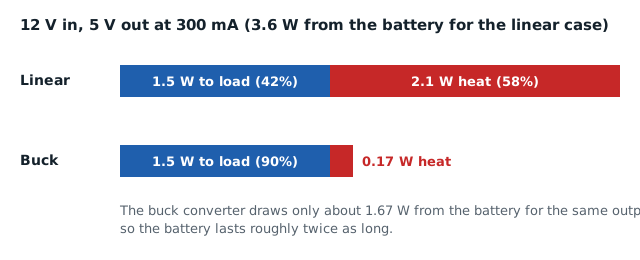
Most projects need 5 V or 3.3 V for the electronics and something else for motors. Rather than finding a battery with exactly the right voltage, choose a battery that suits the motors and use a regulator for the logic. A buck converter is the efficient way to do this, as explained in voltage regulators explained.
Which one should you pick?
- First robot or classroom project: NiMH AA pack.
- Robot car with an Arduino and two gear motors: 2S 18650 Li-ion in a holder with a BMS.
- Fast, lightweight or flying builds: LiPo, with a balance charger and good habits.
Whatever you choose, fit a power switch and fuse, and never short a battery's terminals. Our guide to powering an Arduino project shows how to wire it all together.
— TheSolderBench · found a mistake? tell me