How to Power an Arduino Project
USB, barrel jack, VIN or the 5 V pin? Every way to power an Arduino, how much current each can supply and how to add motors without resets.
→ always join the grounds
section 5, the green band
Batteries, regulators and powering projects safely.
USB, barrel jack, VIN or the 5 V pin? Every way to power an Arduino, how much current each can supply and how to add motors without resets.
→ always join the grounds
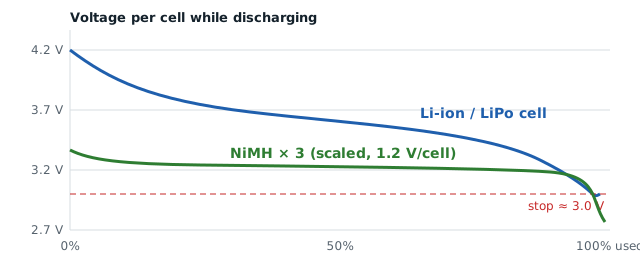
Compare voltage, capacity, current and safety of LiPo, Li-ion 18650 and NiMH batteries, and learn how to choose and charge them for robots.
→ never below 3.0 V per cell
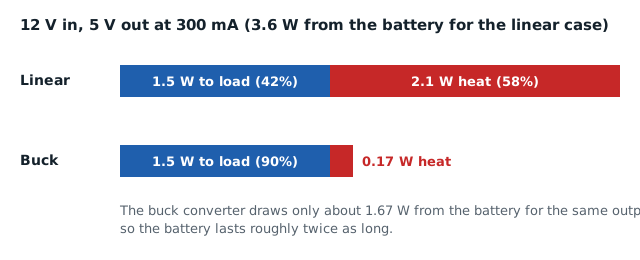
Linear regulators, LDOs and buck and boost converters compared, with heat calculations and advice on choosing the right one for your supply.
→ heat = (Vin − Vout) × I
Ceramic, electrolytic and film capacitors compared, how to read their markings, and which values to use for decoupling, filtering and motor noise.
→ 100 nF next to every chip's power pins
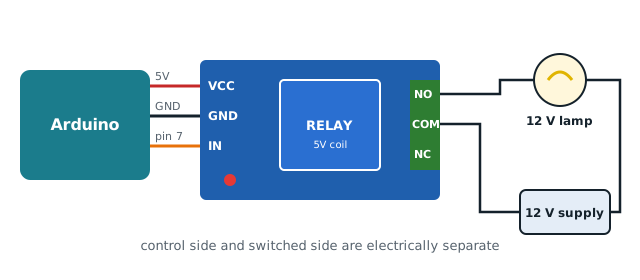
How relay modules let an Arduino switch lamps, pumps and fans, what COM, NO and NC mean, active-low inputs, and the safety rules for higher voltages.
→ COM + NO = off until the relay clicks
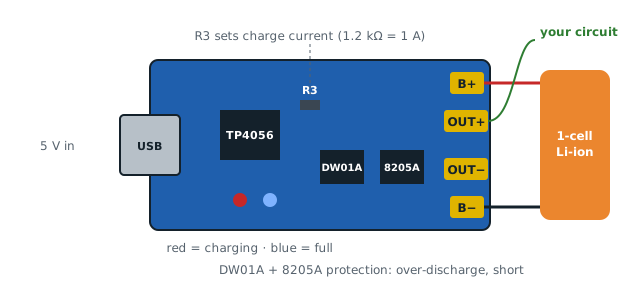
Charge single Li-ion and LiPo cells safely with the TP4056 module, understand B+/B- vs OUT+/OUT-, change the charge current and avoid the common wiring mistakes.
→ one cell only, never in series
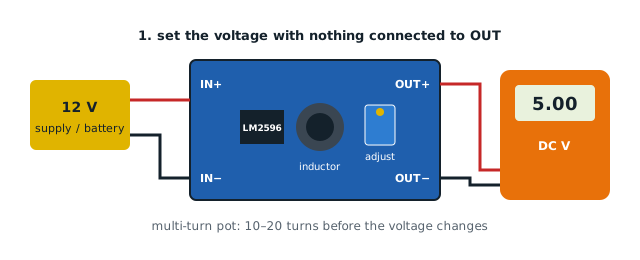
Step a 12 V or battery supply down to 5 V for Arduino projects with the LM2596 module: how it works, setting the output safely, current limits, heat and common mistakes.
→ set the voltage BEFORE connecting anything
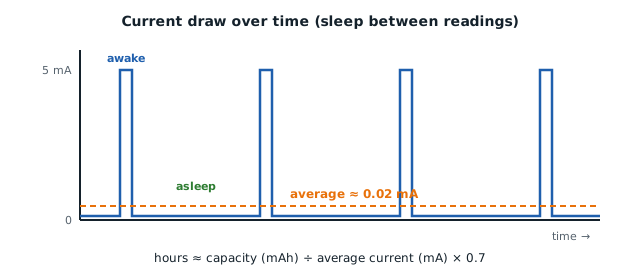
Estimate battery life from capacity and average current, see what typical boards and modules really draw, and use sleep mode to stretch a project from days to months.
→ Hours ≈ capacity (mAh) ÷ average current (mA) × 0.7
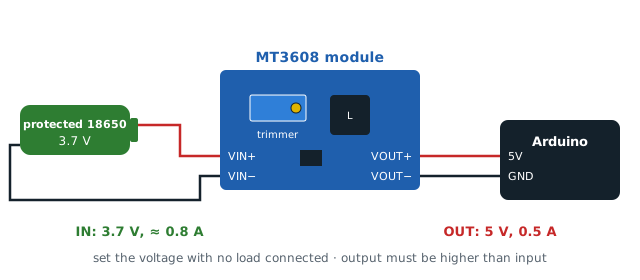
Step a battery voltage up with the cheap MT3608 module, for example 3.7 V Li-ion to 5 V or 5 V to 12 V, with setup steps, current limits, the input-current math and the mistakes that kill batteries.
→ Output power can't exceed input power
Read an adapter's label and pick the right one: voltage, current, polarity symbols, barrel jack sizes, regulated vs unregulated, USB limits and a worked example sizing a supply for an Arduino robot.
→ Match the voltage, exceed the current
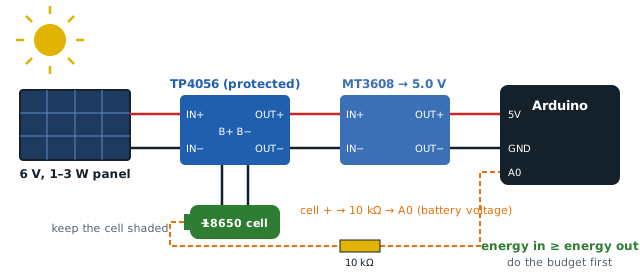
Build a solar-powered Arduino with a small 6 V panel, a TP4056 charger, an 18650 cell and a boost converter. Wiring, an honest energy budget, battery monitoring code and the safety rules for lithium in the sun.
→ Do the energy budget before buying the panel
Which lithium charging module should you use? A clear comparison of the TP4056, IP5306 power bank module, TP5100 1S/2S charger and 2S/3S BMS boards, with what each one actually does, its limits and the project it suits.
→ a BMS protects, it does not charge
What a BMS board does for a 2S or 3S Li-ion pack, how to wire B−, B1, B2, B+ and P− in the right order, how to choose the current rating, which charger to use, and why a new pack sometimes shows 0 V until it's activated.
→ B− first, then up the pack