What Are Voltage, Current and Resistance?
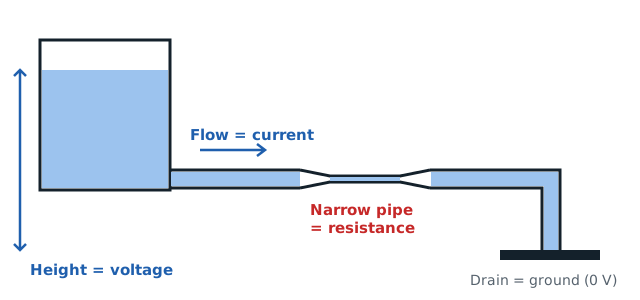
The three quantities behind every circuit, explained with a water-tank model, real numbers and the mistakes beginners make most often.
→ current is drawn, voltage is supplied
section 1, the brown band
Voltage, current, resistance and the laws that tie them together.
The three quantities behind every circuit, explained with a water-tank model, real numbers and the mistakes beginners make most often.
→ current is drawn, voltage is supplied
Use V = I × R to size LED resistors, build voltage dividers and check whether a part will overheat, with worked numbers for each case.
→ convert mA to A before dividing!
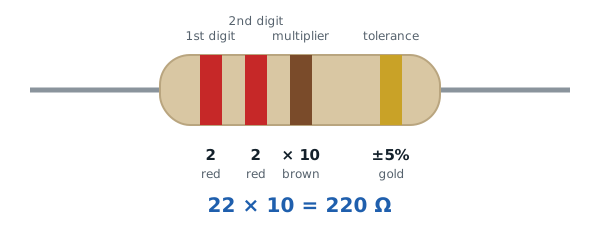
Decode 4-band and 5-band resistors in seconds, with a full color chart, worked examples and tips for telling which end to start from.
→ gold band goes on the right
How current and voltage behave when parts are connected in series or in parallel, with worked examples for resistors, LEDs and batteries.
→ series shares current, parallel shares voltage
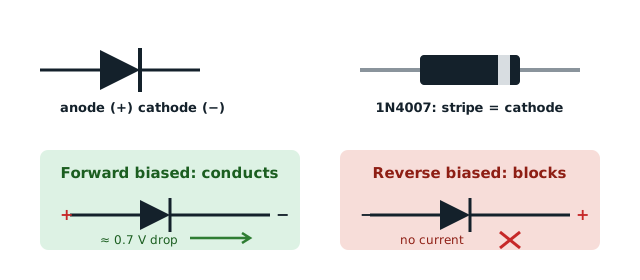
How diodes let current flow one way, what forward voltage means, and how to use rectifier, Schottky and Zener diodes for protection and power.
→ stripe = cathode, current flows toward it
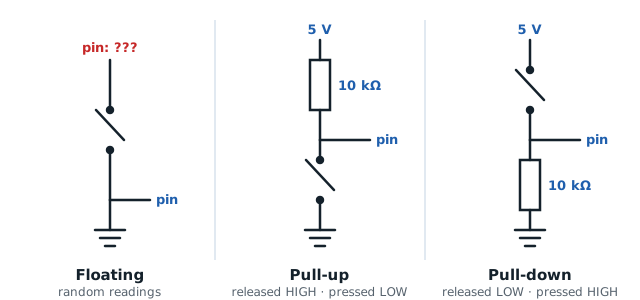
Why a button input floats, how pull-up and pull-down resistors fix it, which value to choose, and how to use the Arduino's built-in INPUT_PULLUP.
→ a floating pin reads random noise
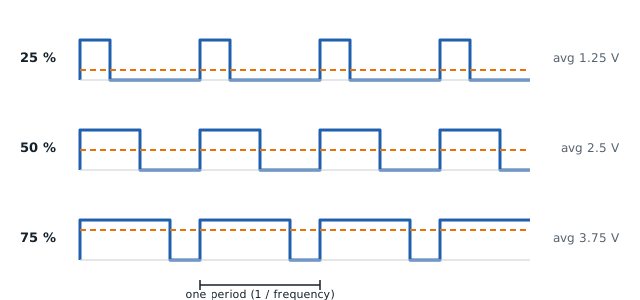
How PWM fakes an analog voltage by switching fast, what duty cycle and frequency mean, and how Arduino's analogWrite() uses it to dim LEDs and control motors.
→ it's a fast switch, not a real voltage
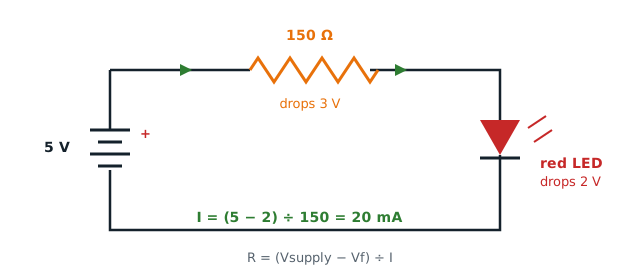
The one formula you need to pick an LED resistor, typical forward voltages by color, worked examples for 5 V and 3.3 V, and how to wire several LEDs safely.
→ R = (supply − LED voltage) ÷ current
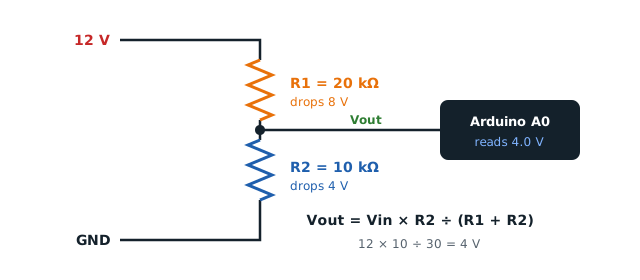
How two resistors scale a voltage down, the formula with worked examples, measuring a 12 V battery with Arduino, shifting 5 V signals to 3.3 V, and why a divider can't power anything.
→ Vout = Vin × R2 ÷ (R1 + R2)
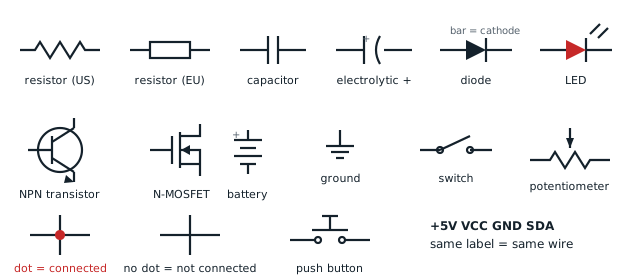
Learn the common schematic symbols, how wires, junctions, power and ground labels work, and how to turn a circuit diagram into a breadboard build, step by step with a worked example.
→ A schematic shows connections, not positions
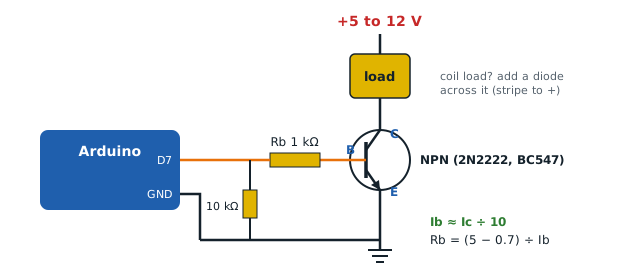
How a bipolar transistor works as an electronic switch, how to wire an NPN like the 2N2222 or BC547 to an Arduino, how to calculate the base resistor, and when to use a MOSFET instead.
→ A small base current controls a big collector current
Kirchhoff's current law and voltage law in plain language, with worked examples on real circuits: LEDs in parallel, a voltage divider and a two-loop circuit you can check with a multimeter.
→ what goes in must come out
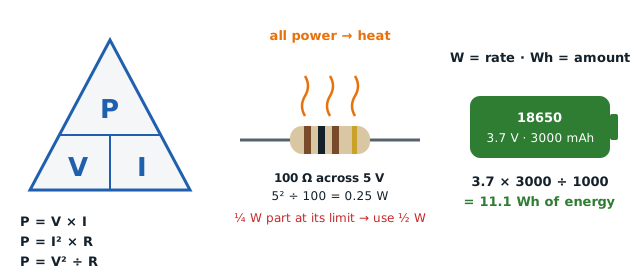
What a watt is, the three power formulas and when to use each, why resistors and regulators get hot, how to pick a resistor's power rating, and the difference between watts, watt-hours and mAh for batteries.
→ P = V × I, and it all ends up as heat