Log #03 · Sep 27, 2026
How to Read Resistor Color Codes
Decode 4-band and 5-band resistors in seconds, with a full color chart, worked examples and tips for telling which end to start from.
Through-hole resistors are too small to print numbers on, so their value is painted on as colored bands. Once you learn the code, you can pick a 220 Ω resistor out of a mixed pile in a couple of seconds. This site even uses it: each category is marked with the color of its number, brown for 1 up to grey for 8.
The color chart
Each color stands for a digit. The same colors mean different things depending on the band's position.
| Color | Digit | Multiplier | Tolerance |
|---|---|---|---|
| Black | 0 | × 1 | |
| Brown | 1 | × 10 | ±1% |
| Red | 2 | × 100 | ±2% |
| Orange | 3 | × 1 k | |
| Yellow | 4 | × 10 k | |
| Green | 5 | × 100 k | ±0.5% |
| Blue | 6 | × 1 M | ±0.25% |
| Violet | 7 | × 10 M | ±0.1% |
| Grey | 8 | ±0.05% | |
| White | 9 | ||
| Gold | × 0.1 | ±5% | |
| Silver | × 0.01 | ±10% |
A common memory aid for the order black to white is the phrase "Better Be Right Or Your Great Big Venture Goes Wrong". Pick any phrase that sticks for you; the point is to remember the sequence 0 to 9.
Reading a 4-band resistor
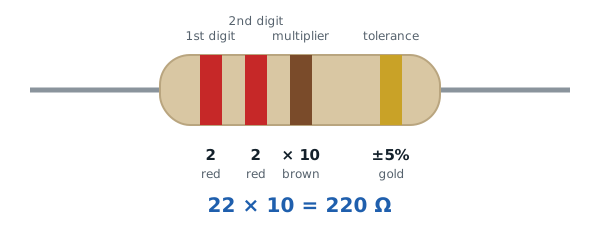
Four-band resistors, usually with 5% tolerance, are the most common in beginner kits.
- Band 1: first digit
- Band 2: second digit
- Band 3: multiplier (how many zeros to add)
- Band 4: tolerance, usually gold
Worked examples
- Brown, black, red, gold: 1, 0, × 100 = 1000 Ω = 1 kΩ
- Yellow, violet, orange, gold: 4, 7, × 1000 = 47 kΩ
- Brown, black, orange, gold: 1, 0, × 1000 = 10 kΩ, the classic pull-up resistor
- Orange, orange, brown, gold: 3, 3, × 10 = 330 Ω, a typical LED resistor
Reading a 5-band resistor
Precision resistors, often with 1% tolerance and a blue body, use three digit bands before the multiplier.
- Bands 1, 2 and 3: digits
- Band 4: multiplier
- Band 5: tolerance, often brown for 1%
Example: brown, black, black, red, brown is 1, 0, 0, × 100 = 10 000 Ω = 10 kΩ ±1%. Notice how the multiplier is one step "lower" than the 4-band version of the same value, because there is an extra digit.
Which end do I start from?
This trips up everyone at first. Some clues:
- The tolerance band (gold or silver) is always the last one. If you see gold at one end, start from the other.
- Tolerance bands are often separated by a slightly larger gap.
- Resistor values follow standard series such as 10, 22, 33, 47, 68. If reading one direction gives 22 kΩ and the other gives a value that does not exist, the first reading is right.
What tolerance means
A 220 Ω resistor with ±5% tolerance can measure anywhere from 209 Ω to 231 Ω and still be in spec. For LEDs, pull-ups and most hobby circuits, 5% is fine. For voltage dividers used in precise measurements, like the battery monitor in our Ohm's law guide, 1% parts give more accurate readings.
When colors are hard to read
Brown, red and orange look alike under warm light, and some people see them differently. Three ways around this:
- Read under daylight or a white LED lamp.
- Measure with a multimeter in resistance mode. It is the quickest way to be certain, and our multimeter guide shows how.
- Keep resistors sorted and labeled in a small drawer organizer, one value per compartment. See our workbench tools list for storage ideas.
Surface-mount resistors
Tiny SMD resistors use printed numbers instead of bands. The three-digit code works like the 4-band system: 221 means 22 × 10¹ = 220 Ω, and 103 means 10 × 10³ = 10 kΩ. A letter R marks the decimal point, so 4R7 is 4.7 Ω.
Practice
Decode these before scrolling to the answers:
- Green, blue, red, gold
- Brown, grey, brown, gold
- Red, violet, yellow, gold
Answers: (1) 5, 6, × 100 = 5.6 kΩ. (2) 1, 8, × 10 = 180 Ω. (3) 2, 7, × 10 k = 270 kΩ.
With resistor values sorted out, you have everything you need to start building. Head to the Arduino section and pick your first board.
— TheSolderBench · found a mistake? tell me