Log #05 · Sep 27, 2026
What Is a Diode and How Does It Work?
How diodes let current flow one way, what forward voltage means, and how to use rectifier, Schottky and Zener diodes for protection and power.
A diode is an electronic one-way valve. Current flows easily in one direction and is blocked in the other. That simple behavior protects circuits from reversed batteries, stops motors from destroying transistors and turns alternating current into direct current. LEDs are diodes too, which is why they only light one way round. This guide explains how diodes behave and which type to use for common jobs.
The two terminals
A diode has an anode (+) and a cathode (−). On the part, the cathode is marked with a band or stripe. In a schematic, the symbol is a triangle pointing at a bar: the triangle shows the direction current flows, and the bar is the cathode.
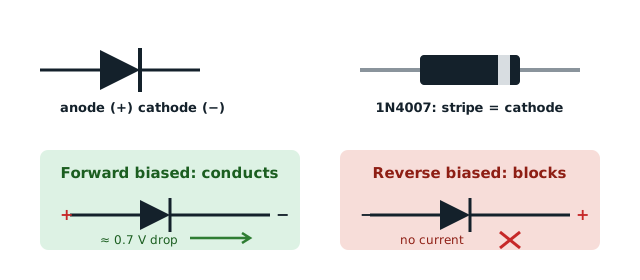
- Forward biased: anode more positive than cathode. The diode conducts.
- Reverse biased: cathode more positive. The diode blocks, apart from a tiny leakage current.
Forward voltage
A conducting diode is not a perfect wire. It "uses up" a roughly fixed voltage called the forward voltage (Vf):
| Diode type | Typical forward voltage |
|---|---|
| Silicon rectifier (1N4007) | about 0.7 V |
| Schottky (1N5819) | about 0.2 to 0.45 V |
| Red LED | about 1.8 to 2.2 V |
| Blue or white LED | about 2.8 to 3.3 V |
This fixed drop is why you calculate an LED resistor using the voltage that is left over, as shown in the Ohm's law guide. It also means a diode in series with a supply lowers the voltage slightly: 5 V through a 1N4007 arrives as roughly 4.3 V.
Key ratings
Every diode datasheet lists a few numbers that matter:
- Maximum forward current: the 1N4001–1N4007 family handles 1 A continuous.
- Maximum reverse voltage: how much reverse voltage it can block. The 1N4007 is rated 1000 V, the 1N4001 only 50 V.
- Recovery speed: how quickly it stops conducting when reversed. It matters for switching circuits.
Our datasheet guide explains where to find these values.
Common diode types
Rectifier diodes
The 1N400x family is the everyday choice for power and protection. Cheap, robust, 1 A. Use them for reverse polarity protection and as flyback diodes on motors and relays.
Schottky diodes
Schottky diodes have a lower forward voltage and switch faster. The 1N5819 (1 A, 40 V) is a popular choice when you cannot afford to lose 0.7 V, such as in battery-powered circuits. Their reverse leakage is higher, and their reverse voltage ratings are usually lower.
Zener diodes
A Zener diode is designed to conduct in reverse once the voltage reaches a precise value, its Zener voltage, such as 3.3 V or 5.1 V. With a series resistor, it can clamp a signal so it never exceeds that voltage. It is useful for protecting an input pin, but it is not an efficient power supply; use a voltage regulator for that.
LEDs
Light-emitting diodes follow the same rules, with a higher forward voltage and a low maximum current, typically 20 mA. They always need a current-limiting resistor.
Three jobs diodes do in hobby projects
1. Reverse polarity protection
Connect a battery backwards and many circuits die instantly. A diode in series with the positive supply line blocks current if the polarity is reversed. The cost is the forward voltage drop, so a Schottky is often the better choice.
The Arduino Uno already has a diode like this on its barrel jack, which is one reason the jack is safer than the VIN pin, as explained in how to power an Arduino project.
2. Flyback protection for motors and relays
Motors, relay coils and solenoids are inductors. When the current through them is switched off suddenly, they produce a large voltage spike, easily tens of volts, in the opposite direction. That spike can destroy the transistor switching them.
A flyback diode connected across the coil, with its cathode toward the positive supply, gives that spike a safe path to circulate and fade away. In normal operation it is reverse biased and does nothing. You will see this diode in the transistor motor driver guide and in every relay module.
3. Rectifying AC to DC
Four diodes arranged as a bridge rectifier turn alternating current into pulsing direct current, which a capacitor then smooths. This is what happens inside wall adapters. For hobby work, buy a ready-made adapter instead of building one for mains voltage.
Testing a diode
Use the diode test mode on a multimeter, described in how to use a multimeter:
- Red probe on the anode, black on the cathode: the meter shows the forward voltage, around 0.5 to 0.7 V for silicon.
- Probes reversed: the meter shows "OL", meaning open.
- A reading near 0 V both ways means the diode is shorted; "OL" both ways means it is open. Either way, replace it.
Quick rules
- The stripe is the cathode.
- Expect about 0.7 V lost across a silicon diode, less across a Schottky.
- Always put a flyback diode across motors, relay coils and solenoids driven by a transistor.
- Check both the current and reverse voltage ratings before choosing a part.
— TheSolderBench · found a mistake? tell me