Log #02 · Sep 27, 2026
Ohm's Law Explained with Real Examples
Use V = I × R to size LED resistors, build voltage dividers and check whether a part will overheat, with worked numbers for each case.
Ohm's law is the one formula you will use on almost every project. It links the three quantities from our voltage, current and resistance guide:
V = I × R
Voltage in volts equals current in amps times resistance in ohms. Rearrange it and you get the other two forms: I = V ÷ R and R = V ÷ I. This guide skips the theory and goes straight to four situations you will meet on the bench, each with the numbers worked out.
The triangle trick
If rearranging formulas slows you down, draw a triangle with V on top and I and R side by side underneath. Cover the value you want and the triangle shows how to get it: cover V and you see I next to R (multiply); cover R and you see V over I (divide).

One rule makes the math painless: convert to base units first. Write 20 mA as 0.020 A and 4.7 kΩ as 4700 Ω. Most wrong answers come from mixing milliamps with amps.
Example 1: an LED on an Arduino pin
An Arduino Uno output pin gives 5 V. A green LED drops about 2.2 V and you want 15 mA through it, a comfortable brightness that keeps the pin well under its limit.
- Voltage across the resistor: 5 − 2.2 = 2.8 V
- R = V ÷ I = 2.8 ÷ 0.015 ≈ 187 Ω
The nearest standard value above is 220 Ω. Check the real current with that value: I = 2.8 ÷ 220 ≈ 12.7 mA. Slightly dimmer, and safer for the pin. You will wire exactly this in your first Arduino sketch.
Example 2: how much current does a resistor draw?
You connect a 10 kΩ resistor between 5 V and ground as a pull-down. How much current flows all the time?
- I = V ÷ R = 5 ÷ 10000 = 0.0005 A = 0.5 mA
That is tiny, which is why 10 kΩ is the usual choice for pull-up and pull-down resistors. A 100 Ω resistor in the same spot would waste 50 mA and get warm for no reason.
Example 3: a voltage divider
A voltage divider is two resistors in series. The output, taken from the middle, is a fixed fraction of the input:
Vout = Vin × R2 ÷ (R1 + R2)
Say you want to measure a battery pack of up to 9 V with an Arduino analog pin, which only accepts up to 5 V. Choose R1 = 10 kΩ on top and R2 = 10 kΩ on the bottom:
- Vout = 9 × 10000 ÷ 20000 = 4.5 V. Safe.
The current through the divider is 9 ÷ 20000 = 0.45 mA, small enough not to drain the battery quickly. In your code you multiply the reading by 2 to get the real battery voltage. Our analog pin guide shows how to convert the raw 0–1023 value to volts.
One warning: a divider only works for measuring. Do not use it to power something. As soon as a load draws current from the middle point, the output voltage sags. For power, use a voltage regulator.
Example 4: will this resistor overheat?
Ohm's law pairs with the power formula, P = V × I. Substituting gives two handy forms: P = I² × R and P = V² ÷ R.
You are dropping 12 V to power a 3 V LED strip section drawing 60 mA, using a resistor.
- Resistor voltage: 12 − 3 = 9 V
- R = 9 ÷ 0.060 = 150 Ω
- P = 9 × 0.060 = 0.54 W
A common 0.25 W resistor would run far beyond its rating and cook. You would need a 1 W part, or better, a more efficient approach such as a lower supply voltage. This check takes ten seconds and saves a lot of burnt fingers.
Quick reference table
| You know | You want | Use |
|---|---|---|
| Current and resistance | Voltage | V = I × R |
| Voltage and resistance | Current | I = V ÷ R |
| Voltage and current | Resistance | R = V ÷ I |
| Voltage and current | Power | P = V × I |
| Current and resistance | Power | P = I² × R |
Where Ohm's law does not apply directly
Resistors follow Ohm's law closely. Some parts do not:
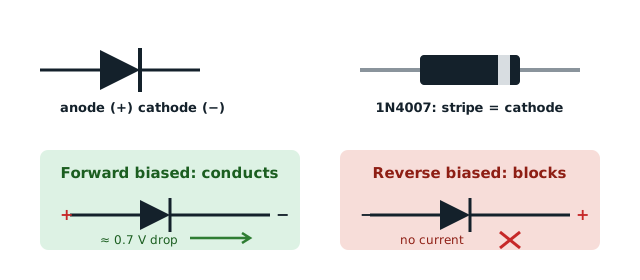
- LEDs and diodes have a roughly fixed voltage drop instead of a fixed resistance. That is why you calculate the resistor using the voltage left over.
- Motors draw much more current when starting or stalled than when spinning freely.
- Filament bulbs have lower resistance cold than hot.
In each case you still use Ohm's law on the parts around them, which is what the examples above do.
Practice problems
Try these, then check with the answers below.
- A 3.3 V ESP32 pin drives a red LED (2.0 V drop) at 10 mA. What resistor?
- What current flows through a 4.7 kΩ resistor across 9 V?
- A 47 Ω resistor carries 100 mA. How much power does it dissipate?
Answers: (1) 1.3 ÷ 0.010 = 130 Ω, use 150 Ω. (2) 9 ÷ 4700 ≈ 1.9 mA. (3) 0.1² × 47 = 0.47 W, so use a 1 W resistor.
Next, learn to find those resistor values in your parts drawer with the resistor color code guide.
— TheSolderBench · found a mistake? tell me