Log #97 · Nov 9, 2026
Electrical Power Explained: Watts, Heat and Power Ratings
What a watt is, the three power formulas and when to use each, why resistors and regulators get hot, how to pick a resistor's power rating, and the difference between watts, watt-hours and mAh for batteries.
Voltage and current tell you how a circuit behaves. Power tells you whether a part will survive it. A resistor with the right value can still burn, a regulator that outputs the right voltage can shut down from heat, and a battery with "more mAh" can hold less energy than a smaller one. All of these come down to watts. This guide explains power with real numbers from the bench.
What a watt is
Power is how fast energy is delivered or used. One watt (W) is one joule of energy per second. In a circuit it's simply:
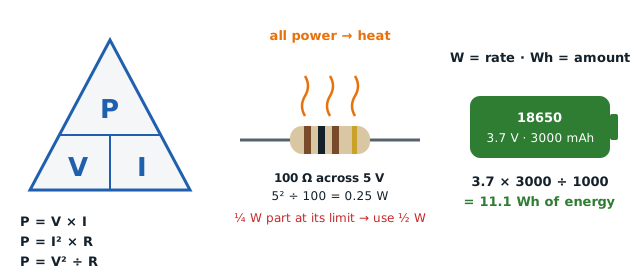
P = V × I (watts = volts × amps)
A USB port supplying 5 V at 0.5 A delivers 2.5 W. An Arduino Uno drawing 50 mA from 5 V uses 0.25 W. A 12 V motor drawing 2 A uses 24 W.
Three ways to write the same formula
Combine P = V × I with Ohm's law (V = I × R) and you get two more forms. Use whichever matches what you know:
| You know | Formula |
|---|---|
| Voltage and current | P = V × I |
| Current and resistance | P = I² × R |
| Voltage and resistance | P = V² ÷ R |
Example: a 100 Ω resistor connected directly across 5 V: P = 5² ÷ 100 = 0.25 W. Same answer from the other path: I = 5 ÷ 100 = 50 mA, and P = 5 × 0.05 = 0.25 W.
Where the power goes: heat
In a motor, power becomes motion (and some heat). In an LED, light (and a lot of heat). In a resistor, all of it becomes heat. That's why the power rating of a part is really a limit on how much heat it can get rid of before it's damaged.
The common through-hole resistor in kits is rated ¼ W (0.25 W). At its full rating it gets hot enough to burn your finger and slowly discolor. A good rule is to keep the actual power below half the rating:
| Resistor rating | Comfortable continuous power |
|---|---|
| ⅛ W (tiny) | up to ~0.06 W |
| ¼ W (standard) | up to ~0.125 W |
| ½ W | up to ~0.25 W |
| 1 W | up to ~0.5 W |
| 5 W (ceramic block) | up to ~2.5 W |
The 100 Ω resistor across 5 V above dissipates 0.25 W, so a ¼ W resistor would be at its limit: use a ½ W part at minimum, or 1 W for comfort.
Example 1: an LED resistor
A red LED from a 5 V pin with a 220 Ω resistor runs at about 14 mA. The resistor drops about 3 V:
P = 3 V × 0.014 A ≈ 0.04 W
Far below ¼ W, so the standard resistor is fine. Every LED resistor calculation for single LEDs ends up like this.
Now try a 12 V LED strip segment drawing 60 mA through a 150 Ω resistor that drops 9 V: P = 9 × 0.06 = 0.54 W. A ¼ W resistor here would overheat. You'd need a 2 W resistor (a 1 W part would already be at the half-rating limit), or better, a different circuit.
Example 2: why "just use a resistor to drop the voltage" fails
Suppose you want 5 V for an Arduino from a 12 V battery and think of dropping 7 V with a resistor. Apart from the fact that the voltage would change with every change in current, look at the power at 100 mA:
P = 7 V × 0.1 A = 0.7 W wasted as heat, more than the Arduino itself uses.
Example 3: linear regulators get hot
A linear regulator like the 7805 or the AMS1117 works the same way: it burns the extra voltage as heat.
Regulator heat = (V in − V out) × current
From 12 V to 5 V at 0.5 A: (12 − 5) × 0.5 = 3.5 W. A 7805 without a heatsink can handle only about 1–1.5 W before it overheats and shuts down. That's why a buck converter, which wastes only 10–20 % of the power, is the better choice for big voltage drops. The trade-offs are covered in voltage regulators explained.
Watts vs watt-hours vs mAh
- Watts (W) = rate: how fast energy is used right now.
- Watt-hours (Wh) = amount: power × time. A 2 W load for 3 hours uses 6 Wh.
- Milliamp-hours (mAh) = charge, which only means energy when you also know the voltage.
To compare batteries, convert to watt-hours:
Wh = V × mAh ÷ 1000
| Battery | Voltage | Capacity | Energy |
|---|---|---|---|
| 18650 Li-ion | 3.7 V | 3000 mAh | 11.1 Wh |
| 4 × AA NiMH pack | 4.8 V | 2000 mAh | 9.6 Wh |
| 2S LiPo | 7.4 V | 2200 mAh | 16.3 Wh |
| 9 V battery | 9 V | ~500 mAh | ~4.5 Wh |
The 2S LiPo has fewer mAh than the 18650 but holds almost 50 % more energy. Watt-hours are also what airlines limit (usually 100 Wh per battery) and what you need for runtime estimates like those in how long will a battery run my Arduino.
Power ratings on other parts
- Power supplies and adapters list maximum watts or amps: a 5 V 2 A adapter can supply up to 10 W. See choosing a power adapter.
- Transistors and MOSFETs have a maximum power dissipation that depends heavily on cooling; the datasheet value usually assumes a large heatsink.
- Motors list rated power at a specific voltage; at stall they can draw several times that.
- Speakers list watts too, but that's the electrical power they can handle, not how loud they are.
Quick checks for any circuit
- For every resistor, compute P = I² × R or P = V² ÷ R, and keep it under half its rating.
- For every linear regulator, compute (V in − V out) × I. Over about 1 W, add a heatsink or switch to a buck converter.
- For batteries, compare watt-hours, not just mAh.
- If something gets too hot to touch for more than a second, it's dissipating more power than it should. Turn it off and recalculate.
— TheSolderBench · found a mistake? tell me